 16000 Ventura Blvd, Ste 400, Encino, CA, United States, 91436



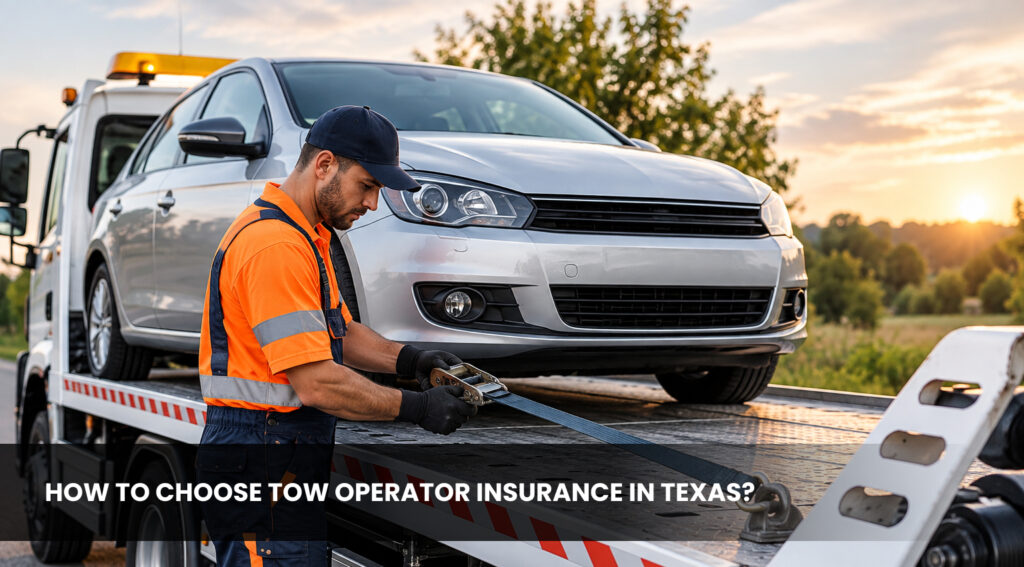
How to Choose Tow Operator Insurance in Texas?
Choosing Tow Operator Insurance in Texas starts with understanding what your towing business actually does, how many trucks you operate, and what you are legally required to carry. Texas requires tow companies to maintain liability insurance for each permitted tow truck, with minimum amounts varying by permit type.
But meeting the minimum is only the starting point. The right policy should protect your trucks, customers' vehicles, employees, property, and business operations.
What insurance does a Texas towing company need?
Texas towing operations face risks that ordinary commercial vehicles do not. A tow truck may be involved in an accident, damage a customer's vehicle while it is being transported, or become involved in a dispute over property or storage.
Texas currently sets minimum liability and cargo or cargo-on-hook requirements based on the type of towing permit.
| Texas towing permit | Minimum liability | Cargo or cargo-on-hook |
| Incident Management | $500,000 | $50,000 |
| Private Property | $300,000 | $50,000 |
| Consent Towing | $300,000 | Not required |
The Texas Department of Licensing and Regulation also requires the insurance to come from an insurer authorized to do business in Texas.
Why is minimum coverage not always enough?
A legal minimum is designed to establish a baseline. It is not necessarily designed around your company's actual exposure.
Imagine a towing contractor operating five trucks and regularly handling damaged vehicles after highway accidents. The business could face several simultaneous exposures:
- Third-party bodily injury
- Property damage
- Damage to a customer's vehicle
- Damage to the tow truck itself
- Theft
- Employee injuries
- Garage or storage-related claims
- Equipment damage
This is where broader Towing Contractor Coverage becomes important.
What should your towing insurance policy include?
A strong commercial policy can combine several coverages depending on your operation.
1. Liability coverage
This protects against claims for bodily injury or property damage caused by your business operations.
2. Physical damage coverage
This can protect your own tow trucks against collision, theft, fire, vandalism, and other covered losses.
3. On-hook coverage
This is particularly important because you are often responsible for another person's vehicle while towing it.
4. Garagekeepers coverage
If customers' vehicles are stored at your premises, garagekeepers legal liability may be worth considering.
5. Workers' compensation
If you employ drivers or other workers, workplace injury protection should also be evaluated based on applicable requirements.
How does fleet size change your insurance needs?
Fleet Insurance for Towing Companies becomes especially useful as the number of trucks grows.
Instead of treating every vehicle as an isolated business asset, a fleet policy can help organize coverage across multiple vehicles and drivers.
| Business profile | Main insurance concern | Policy discussion |
| One-truck operator | Affordability | Essential liability and physical damage |
| Small fleet | Multiple vehicle exposure | Fleet structure and driver records |
| Growing fleet | Operational complexity | Fleet insurance and broader liability |
| Large towing company | High aggregate exposure | Customized commercial program |
The right structure depends on your vehicles, drivers, services, territory, claims history, and contracts.
What should a small towing business look for?
Small Towing Business Insurance should balance protection with affordability.
A smaller operator may not need every available coverage, but cutting important protection simply to reduce a premium can backfire badly after one serious accident.
When requesting quotes, prepare information about:
- Number of tow trucks
- Truck types and values
- Driver records
- Years in business
- Types of towing performed
- Operating radius
- Storage operations
- Claims history
- Estimated annual mileage
- Contract requirements
The more accurate your information, the more useful your quote will be.
How can you compare towing insurance quotes?
Do not compare only the premium.
Look at the coverage limits, deductibles, exclusions, endorsements, and covered operations.
A $500 cheaper policy is not a bargain if it leaves a major exposure uninsured.
Ask the agent:
- What exactly is covered?
- What is excluded?
- Is on-hook coverage included?
- Does the policy cover every truck?
- Are newly acquired vehicles automatically covered?
- What happens when a driver is added?
- Are storage operations covered?
- What deductible applies to physical damage?
What does Texas require for tow truck insurance?
Texas requires proof of insurance for permitted tow trucks. The exact minimum depends on the permit type, and policies must be issued by an authorized insurer.
Insurance certificates must also meet state requirements, including a provision regarding cancellation notice.
So yes, compliance matters. But good risk management goes further than checking a regulatory box.
Protect the trucks that keep your business moving
Towing is already a high-risk business. Your insurance should not add another layer of uncertainty.
e360 Insurance Services helps towing businesses evaluate specialized coverage, including liability, physical damage, on-hook protection, and other commercial insurance options.
Request a consultation or simply call 888-862-6750.
Build coverage around your trucks, drivers, and real-world operations.